


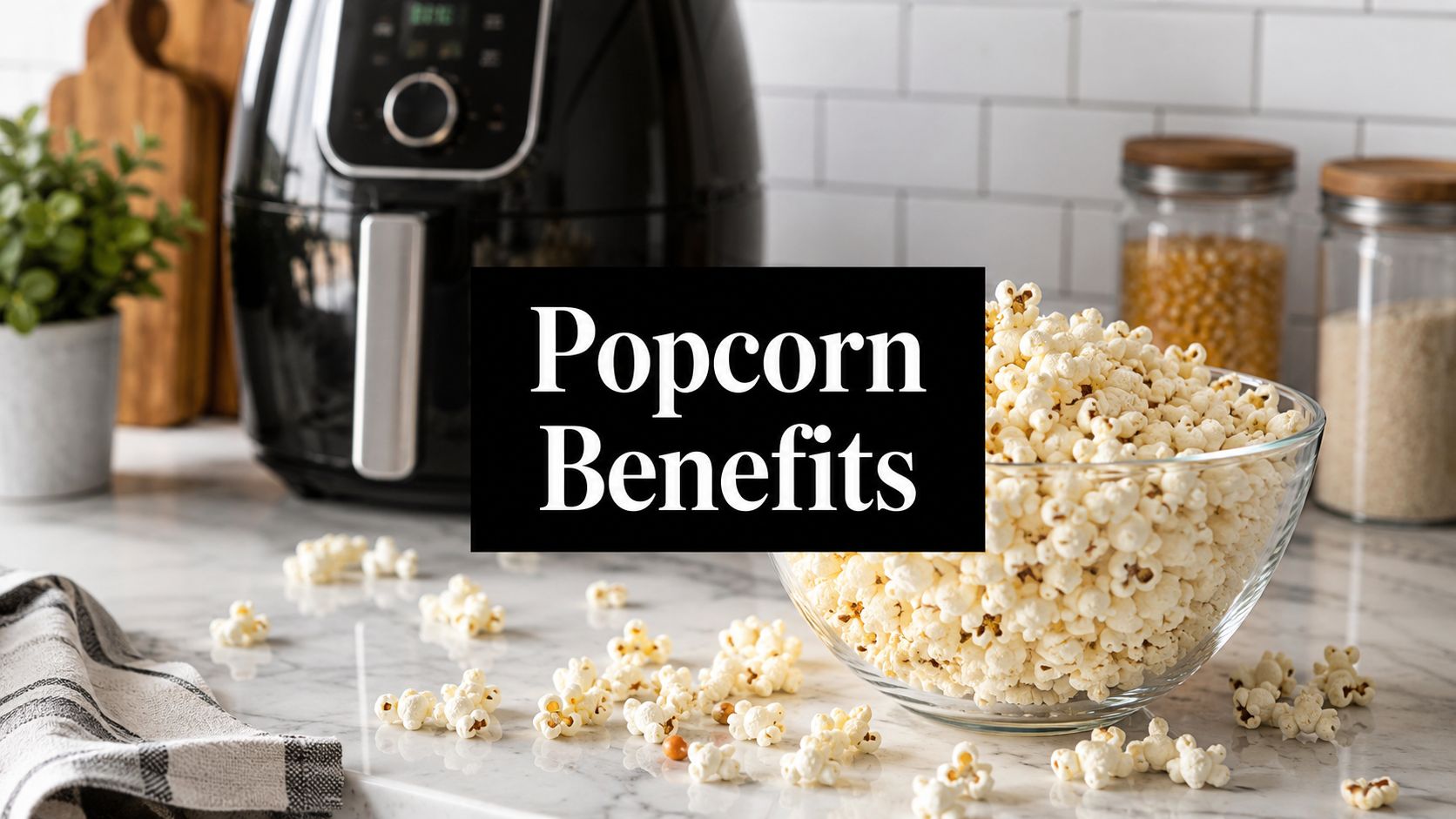
Most advice about popcorn gets one big thing wrong. People talk about it like the food itself is the problem, when the actual issue is usually what gets poured on top of it.
Movie theater popcorn, caramel corn, buttery microwave bags, and oversized tubs have trained a lot of people to think popcorn belongs in the same category as candy or chips. But the plain kernel tells a different story. Popcorn is a whole grain snack with real nutritional value. The catch is simple. The benefits of eating popcorn only show up when you cook it in a way that protects what makes it healthy in the first place.
That's why preparation matters more than is commonly understood. Air-popped popcorn can be light, filling, and easy to fit into a healthy routine. Popcorn drenched in butter, oil, sugar, or heavy salt is a different food experience with a very different nutritional outcome. If you've been curious about healthier snack ideas, the recipes and guides on the Air Fryer Snack Ideas blog can help you think beyond the standard bagged options.
Rethinking Your Favorite Movie Snack
A lot of healthy eaters avoid popcorn because they associate it with excess. Excess butter. Excess salt. Excess mindless snacking. That's understandable, but it also misses the point.
Popcorn is one of those foods that can swing in two very different directions. One version is a heavily flavored convenience snack. The other is a simple whole grain that can support fullness, digestion, and better snack choices during a busy day.
The junk food myth
Popcorn got its bad reputation from the company it keeps. If you buy it coated in butter-like flavoring or candy, it stops behaving like a light whole grain snack and starts acting more like a dessert or fast-food side. That doesn't mean the kernel itself is the problem.
Think about a plain potato versus deep-fried chips. The base ingredient matters, but the cooking method decides a lot.
Practical rule: Don't ask whether popcorn is healthy. Ask whether your version of popcorn is prepared in a healthy way.
Why this matters in everyday life
This distinction matters most when you're hungry and need something that feels satisfying right away. Students studying late, parents grabbing a quick snack, and professionals trying not to raid the office vending machine all need foods that are convenient and filling.
Popcorn can do that job well because it offers crunch, volume, and flexibility. It can feel like a treat without automatically becoming one of those snacks that leaves you wanting more five minutes later.
The main lesson is simple. Popcorn isn't automatically healthy or unhealthy. It becomes one or the other based on how you make it.
The Nutritional Power of a Single Kernel
A popcorn kernel looks tiny and plain, but nutritionally it has more going on than generally expected. The first thing to know is that popcorn is a whole grain. That means it keeps the parts of the grain that give it its natural structure and nutritional value, instead of being refined down into a more processed form.
That matters because whole grains are linked with better long-term health patterns. Major health sources emphasize that popcorn is a whole grain, and whole-grain intake has been linked to lower risk of heart disease, diabetes, and some cancers, while WebMD reports that popcorn contains phenolic acids, a type of antioxidant, and Cleveland Clinic notes that ounce for ounce, popcorn has more antioxidants than fruits and vegetables, as explained in WebMD's overview of popcorn's health benefits.
What whole grain means in plain language
When people hear “whole grain,” they often think of bread labels. With popcorn, it's easier to picture. You're eating the grain in a form that stays close to its natural state. That's one reason it can be a smarter snack than many ultra-processed crunchy foods.
Whole-grain popcorn brings a few practical advantages:
- Fiber for fullness: Fiber helps a snack feel more satisfying.
- A sturdier structure: Whole grains usually take more chewing than soft, processed snacks.
- Plant compounds beyond basic calories: Popcorn offers more than just crunch.

Why antioxidants matter here
The word antioxidants can sound abstract, so here's the simpler version. These are plant compounds that help protect cells from damage caused by everyday stress in the body. Popcorn contains phenolic acids, which are one type of antioxidant.
That surprises many people because popcorn doesn't look like a “health food.” It looks like party food. But foods don't have to look serious to offer something useful.
Popcorn isn't nutritionally empty. It's a whole grain with fiber and protective plant compounds, especially when you keep preparation simple.
Why the kernel itself deserves more credit
A lot of snack foods are built to taste intense but offer very little staying power. Popcorn is different. The kernel starts with a more solid nutritional foundation before you add any seasoning at all.
If you want a helpful way to compare snacks, ask these questions:
| Question | Plain popcorn answer |
|---|---|
| Is it a whole grain? | Yes |
| Does it offer fiber? | Yes |
| Does it contain antioxidant plant compounds? | Yes |
| Does it need heavy toppings to be enjoyable? | No |
That last point matters. A good snack shouldn't require a flood of butter, sugar, or salt to become edible. Popcorn has a natural toasted flavor that works with savory spices, herbs, or light seasoning.
How You Cook Popcorn Changes Everything
Two bowls of popcorn can look similar and still behave very differently in your diet. One can be light and balanced. The other can be greasy, overly salty, and easy to overeat.
That's why the benefits of eating popcorn depend so heavily on how you prepare it. The cooking method doesn't just affect taste. It changes the amount of added fat, the intensity of flavor, and even how much of the original grain character remains noticeable.
A side by side look at common methods
Here's the practical comparison many find useful:
| Method | What usually helps | What usually hurts |
|---|---|---|
| Air-popped | Little to no added fat, clean flavor, easy portioning | Can taste bland if under-seasoned |
| Air fryer style dry popping | Similar benefits to air-popping, convenient for home use | Requires a bit of trial and error |
| Stovetop with oil | Good flavor control, fresh texture | Easy to use more oil than you meant to |
| Pre-packaged microwave bags | Convenient | Often comes with heavy flavoring, added fat, and salt |

Why air-popping has the edge
Cleveland Clinic notes that popcorn is a meaningful source of polyphenol antioxidants, especially phenolic acids such as ferulic acid, that these compounds are concentrated in the hull, and that preparation methods using excessive oil or high heat can affect their stability, while the clean, dry heat of air-popping helps preserve them, according to Cleveland Clinic's discussion of popcorn benefits.
That's the big reason air-popping stands out. It doesn't bury the grain under oil, and it doesn't rely on heavy add-ins to create flavor. It lets the popcorn stay closer to what it already is.
Where people accidentally turn it into junk food
Most popcorn mistakes happen after popping, not before. A person starts with a healthy base and then adds enough butter, sweet coating, or salt to wipe out the advantage.
Watch for these common shifts:
- From light to heavy: A generous pour of melted butter changes the snack fast.
- From whole grain to dessert: Caramel, candy drizzle, and sugary coatings move it into treat territory.
- From satisfying to compulsive: Strong artificial flavors can make it easier to keep grabbing handfuls.
The healthiest popcorn usually looks a little plain before seasoning. That's not a flaw. It's the sign that you still control what goes into the bowl.
For most home cooks, the best middle ground is simple. Use dry heat, add flavor lightly, and let the popcorn stay recognizable as popcorn.
Practical Health Benefits You Can Feel
The strongest real-world reason to eat popcorn isn't that it sounds impressive on a nutrition label. It's that it can help with weight management and fullness in a way that many snack foods don't.
Medical News Today notes that popcorn's strongest benefit is weight management because it's a low-energy-density whole grain, and that 1 cup (8 g) of air-popped, unsalted popcorn contains 30.6 calories and about 0.96 g of protein, while its high fiber content and low calorie count increase satiety and may help people eat fewer calories overall, as described in Medical News Today's popcorn nutrition guide.
Why low energy density helps
Low energy density means you get a lot of food volume for relatively few calories. That matters because hunger isn't only about calories. It's also about physical satisfaction.
A small handful of dense snack food can disappear fast and leave you feeling like you barely ate. Popcorn tends to do the opposite. It gives you a bowl that looks generous, feels substantial, and takes longer to eat.

The biggest everyday benefits
The practical benefits of eating popcorn often show up in ordinary moments:
- Afternoon snack control: A bowl of plain or lightly seasoned popcorn can interrupt the urge to go straight for chips or cookies.
- Evening eating awareness: It gives you something crunchy and snack-like without making “movie night” automatically mean a heavy treat.
- Digestive support: The fiber in whole-grain popcorn can help a snack feel more useful, not just entertaining.
- A better default option: It's easier to build a healthy routine around popcorn than around candy or buttery crackers.
Fullness is the key advantage
The American Heart Association notes that popcorn's high satiety comes from its fiber content, low calorie count, and low energy density, and also points to a comparison where popcorn produced greater fullness than an equivalent calorie amount of potato chips. That's one reason many health-conscious snackers choose it when they want something filling instead of just flavorful.
You don't have to be dieting to benefit from that. You might just want a snack that helps you stop thinking about snacks for a while.
Quick reminder: A healthy snack should solve hunger, not simply entertain your mouth for ten minutes.
If you enjoy learning from people who focus on practical, approachable food guidance, you may like browsing the contributors featured on the Air Fryer Snack Ideas authors page.
Making Perfect Air Fryer Popcorn
Air fryers make healthy popcorn feel easier to repeat. That's a key advantage. A method doesn't help much if it's so fussy that you only use it once.
An air fryer can give you the main advantage of air-popping with less mess and a setup many home cooks already use for snacks. The result is a bowl that stays close to popcorn's whole-grain strengths while still feeling fresh and fun to eat.

A simple method that works
Air fryers vary, so treat this as a starting method and adjust for your machine.
- Check your air fryer basket size. You need enough room for popped kernels to expand.
- Use plain popcorn kernels. Skip packets with built-in flavoring.
- Line or contain the kernels if needed. Some air fryers need a perforated liner or a small oven-safe dish to keep kernels from blowing around.
- Use a moderate temperature setting. Too much heat can scorch kernels before they pop well.
- Cook in short intervals. Listen for the popping to slow, then stop before the batch burns.
- Season after popping. This gives you much better control.
If your air fryer tends to blow lightweight kernels into the heating area, use an accessory that keeps them contained while still allowing airflow. That one tweak usually makes the process much smoother.
Healthy seasoning ideas people actually enjoy
Plain doesn't have to mean boring. The best air fryer popcorn seasonings add flavor without turning the snack into a butter delivery system.
Try combinations like these:
- Savory and cheesy tasting: Nutritional yeast with a little garlic powder
- Warm and smoky: Smoked paprika and black pepper
- Simple and classic: A light pinch of salt
- Sweet leaning without becoming dessert: Cinnamon on lightly misted popcorn
- Herby: Dried dill or Italian seasoning
Some people like to add a tiny mist of oil so seasonings stick better. That can work well if the goal is just adhesion, not saturation.
Why this method supports fullness better
The American Heart Association notes that the feeling of fullness, or satiety, is a key benefit of popcorn, and one study found that popcorn produced greater fullness than an equivalent calorie amount of potato chips, largely due to its bulk and fiber, as explained in the American Heart Association article on popcorn as a snack.
That's one reason air fryer popcorn is such a smart habit snack. It helps you preserve the traits that make popcorn useful in the first place. You're not burying the volume and fiber under heavy toppings.
One smart habit to borrow
Pair popcorn with a routine, not just a craving. Make it when you start your evening study session, when you need a break from sweets, or when you want a crunchy side for a sandwich lunch.
If you already use your air fryer for breads and quick snacks, you may also enjoy trying a bagel in the air fryer for a fast breakfast or snack. The point isn't to eat popcorn all day. It's to make better snacking feel automatic.
Avoiding Common Popcorn Pitfalls
The healthiest popcorn habits are simple, but they do require some honesty. Individuals don't run into trouble because popcorn is unhealthy itself. They run into trouble because they start with a good base and then pile on enough extras to cancel the benefit.
The mistakes that matter most
Watch for these common pitfalls:
- Turning seasoning into a coating: A light touch adds flavor. A heavy pour changes the whole snack.
- Buying for convenience alone: Microwave bags and flavored packaged popcorn can make it harder to control what you're eating.
- Eating without noticing quantity: Even a better snack deserves attention if you keep refilling the bowl.
- Confusing “homemade” with “healthy”: Stovetop popcorn loaded with oil and butter can still be heavy.
A simple filter for smarter choices
When you're deciding whether your popcorn is helping or hurting, use this quick check:
| Ask yourself | Better answer |
|---|---|
| Did I start with plain kernels? | Yes |
| Did I use dry heat or minimal added fat? | Yes |
| Can I still taste the popcorn itself? | Yes |
| Did I add just enough seasoning, not a coating? | Yes |
That's the whole framework. Keep the grain recognizable. Keep the toppings light. Keep the portion intentional.
Popcorn doesn't need to be perfect to be healthy. It just needs to stay close to what made it a good snack in the first place.
If you want more practical snack ideas that work with real schedules and real kitchens, visit airfryersnackideas.com. You'll find air fryer snack inspiration that helps you make crunchy, satisfying options at home without overcomplicating healthy eating.
