


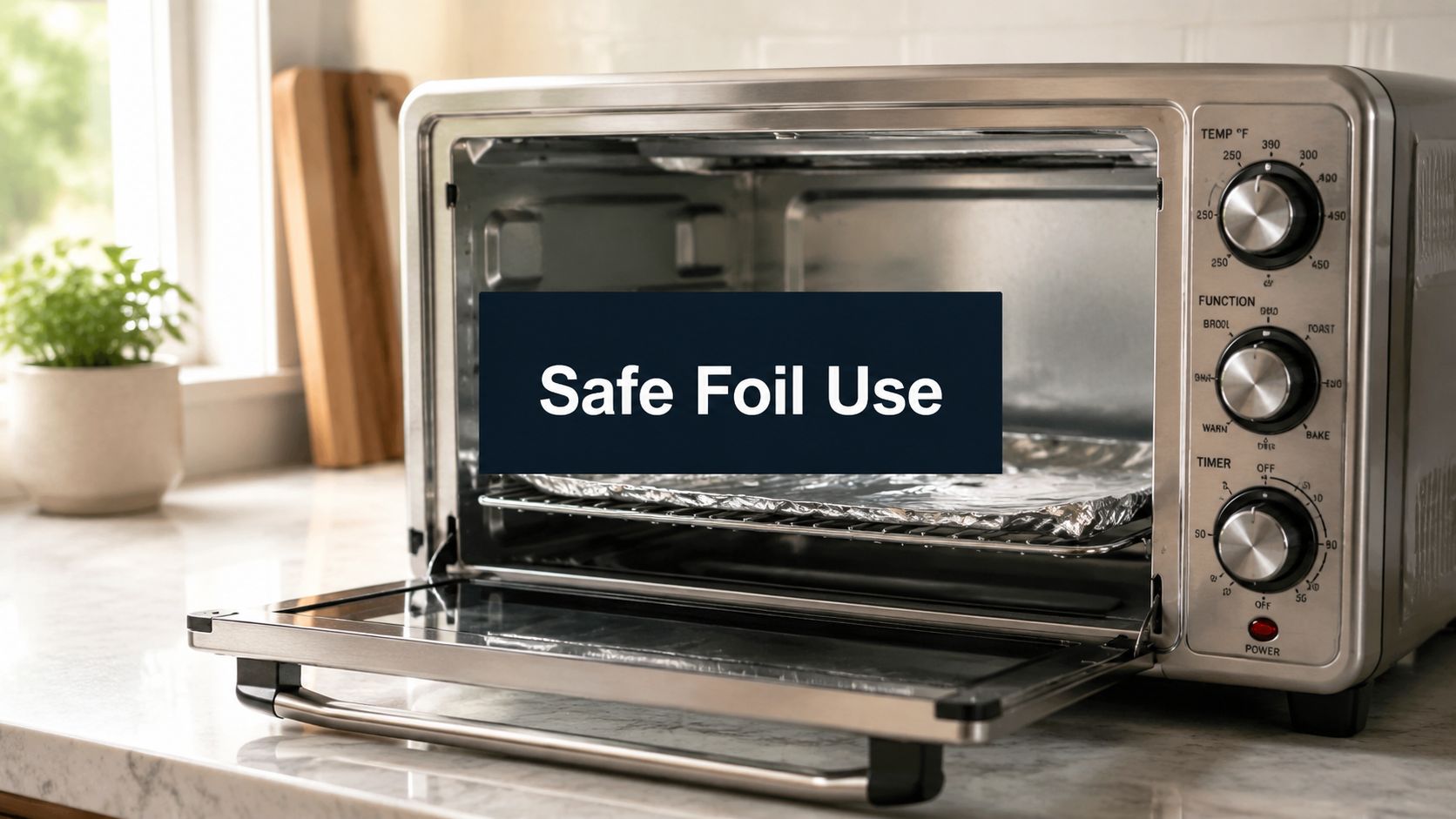
Yes, you can use aluminum foil in a toaster oven, but only if you follow strict safety rules. If foil touches the sides or heating elements, some manufacturer guidance warns the oven may heat above 500°F, and a separate food-safety study found aluminum levels in some tested foods rose by as much as 40 times during foil cooking.
You're probably here because you've got something small to heat. Leftover pizza, garlic bread, nachos, maybe a bagel half with cheese. The foil box is right there, and using it feels faster than washing a pan.
That instinct makes sense. Foil is convenient. But with aluminum foil in a toaster oven, convenience only counts if the foil stays controlled, secure, and well away from the hot parts. Toaster ovens are tight little cooking chambers. A small mistake that would barely matter in a full-size oven can create sparks, overheating, or a ruined appliance in a toaster oven.
My advice is simple. Use foil only when you can keep it contained on a pan or closely wrapped around food without any chance of drifting, lifting, or touching the oven interior. If you can't do that, skip it and grab parchment or a small pan instead.
The Quick Answer to Using Foil in Your Toaster Oven
You've got leftover pizza in one hand and the foil box in the other. Fine. Use the foil only if you can keep it flat, secure, and fully contained.
The quick answer is yes, but only for controlled jobs. Foil is fine on a small pan, under messy foods, or wrapped snugly around something sturdy like garlic bread. It is a bad choice for lining the toaster oven, covering the crumb tray, or placing loose sheets inside a model with strong fan circulation.
Here's the rule I recommend: if the foil can shift, flap, curl, or reach any hot surface, don't use it.
That matters even more with snack cooking because toaster ovens do very different jobs. A basic reheating model may handle a small foil packet without trouble. A convection or air-fry toaster oven moves hot air hard and fast, so a loose edge that seems harmless can become a problem quickly. The same piece of foil that works for reheating half a sandwich can ruin a batch of fries or wings by blocking airflow and reflecting heat where you do not want it.
Use foil for contained, low-mess situations. Skip it for foods that need circulating heat to crisp well.
- Use foil on a pan for saucy nachos, drippy baked potatoes, or a tightly wrapped piece of bread.
- Skip foil for toast, fries, nuggets, wings, and anything you are cooking on air-fry mode.
- Never use foil as a full interior liner or as a loose sheet placed directly in the oven.
That's the practical answer. Foil can help, but only in narrow situations where you control exactly where it sits and how the heat moves around it.
Why Toaster Ovens and Foil Can Be a Risky Mix
A toaster oven looks harmless because it's small. That's exactly why foil can cause trouble so fast.

The cavity is tight and the heat is aggressive
In a full oven, there's more room between food, foil, walls, and heating elements. In a toaster oven, everything sits closer together. That means a loose corner of foil has less distance to travel before it becomes a real problem.
Independent appliance guidance points to the main issue clearly. In a toaster oven, the biggest hazard isn't the foil metal by itself. It's blocked airflow and radiant heat reflection. Covering the crumb tray, oven floor, or even a full rack can trap heat, disrupt circulation, and create uneven browning or localized overheating, as explained in this appliance safety overview from Mountain High Appliance.
Three things go wrong
Here's what happens inside the oven:
| Hazard | What it does | Why it matters for snacks |
|---|---|---|
| Heat reflection | Foil bounces heat back toward nearby surfaces | Cheese burns before bread crisps |
| Airflow blockage | Foil interrupts the movement of hot air | Fries and nuggets turn patchy and soggy |
| Element contact | Foil touches a very hot component | Sparks, smoke, or fire risk |
That's why lining the bottom seems smart for cleanup but is usually a bad idea. You're not just catching drips. You're changing how the oven was designed to move heat.
A toaster oven works best when hot air can move freely around the food. Foil often interferes with that before it helps you.
Air-fry models need even more caution
Air-fryer toaster ovens are less forgiving than old-school toast-and-bake models. They use stronger airflow, and that airflow can lift light foil or push up corners that looked secure when you closed the door.
That's why the same foil setup that seems fine for reheating a slice of pizza on bake mode may be a bad choice on air-fry mode. The fan changes the risk.
My opinion is firm here. If your toaster oven has a strong fan, use foil only when it's pressed tightly to food or anchored by the rim of a pan. Loose foil in a high-circulation oven is asking for trouble.
The Official Rules for Safe Foil Use
Use foil for the food, not for the machine. That single decision prevents most toaster oven mistakes.

The core safety rules
Brand manuals differ on details, but the safe pattern is consistent. Keep foil away from heating elements and oven surfaces. Do not use it to line parts of the oven. Do not let it block airflow.
Follow these rules every time:
Keep foil on food or inside a pan.
A foil packet around a potato is one thing. A sheet spread across the oven interior is a mistake.Cut small pieces, not oversized sheets.
Extra foil creates extra risk. Leave clear space between the foil and every interior surface.Press and crimp every edge firmly.
Loose corners are a problem, especially in air-fry models with strong fan circulation.Use foil to solve a cooking problem, not a cleanup problem.
Wrap a sandwich half to keep it from drying out. Line a small pan for sticky nachos. Do not line the oven floor because you expect cheese to drip.Choose a pan first when the food is greasy, cheesy, or likely to bubble over.
Foil works best with structure under it. A pan keeps it flat, contained, and less likely to shift.
Best uses and bad uses
Foil is useful in a toaster oven when the job is specific and controlled.
Good uses
- Wrapping food snugly: Good for a baked potato, a breakfast burrito, or part of a sandwich you want to heat gently.
- Lining a small toaster oven pan: Helpful for messy snacks if the foil stays tucked inside the rim.
- Shielding one spot on the food: A small, tight piece over a crust edge or lasagna corner can slow over-browning.
Bad uses
- Covering the whole rack: Airflow drops and food cooks poorly.
- Placing a loose sheet under air-fried snacks: The fan can move it.
- Using foil close to top elements on broil-style settings: Clearances are tighter and mistakes happen faster.
Here is my kitchen rule. If the foil can slide, puff up, curl, or touch something hot after the door closes, do not use it that way.
Model type changes the right choice
Generic advice becomes inadequate. The right foil setup for one toaster oven can be a bad call in another.
A basic bake-only model may handle a foil-lined pan without trouble. A compact toaster oven with tight interior space gives you less margin for error. An air-fry toaster oven needs the most caution because moving air can lift light foil, especially under fries, nuggets, or reheated pizza.
That is why snack-by-snack judgment matters. For a toasted sandwich, a tight wrap can work well. For tater tots on air-fry, skip the loose foil and use the basket or pan the oven came with.
Whirlpool makes the broader point clearly in Whirlpool's appliance guidance on foil use and model-specific instructions. Check your manual before you copy a tip from a general cooking blog.
My recommendation is simple. In air-fry toaster ovens, treat foil as a limited-use tool. For everyday snack cooking, pans, baskets, parchment, and silicone liners are usually the better choice.
Red Zones Where Foil Should Never Go
Some spots inside a toaster oven are automatic no-go zones.

The crumb tray
Don't line it. Not even “just this once” for cheese drips.
The crumb tray exists to catch debris while still allowing the oven to manage heat the way it was designed to. Covering it with foil interferes with that. Cleanup gets easier, but overheating risk goes up. That trade is bad.
The oven floor and walls
This is the other common mistake. People line the bottom because they're thinking like they would with a full-size oven.
That doesn't translate well. In a toaster oven, foil on the floor or walls can trap heat where it shouldn't, reflect heat back toward sensitive areas, and turn a simple reheat into an appliance problem.
The full rack
A rack covered edge to edge with foil stops the oven from doing its job. Air can't circulate normally around the food, and snacks cook unevenly. Crisp foods stay limp. Greasy foods smoke more easily. The oven works harder and performs worse.
If foil is acting like a liner for the machine instead of a wrapper for the food, it's probably in the wrong place.
Anywhere near a heating element
This one's obvious, but it's worth saying plainly. Foil must never touch a heating element. If your setup leaves any doubt, it's not safe enough.
Safer Alternatives for Toaster Oven Cooking
If you're tired of second-guessing foil, good. There are better options for a lot of everyday toaster oven jobs.

Use the tool that matches the snack
A peer-reviewed study found that cooking food in aluminum foil can increase aluminum contamination in food by as much as 40 times in some tested samples, especially with conditions that encourage transfer. The paper also notes an EFSA tolerable weekly intake of 2 mg/kg of body mass per week, which matters more for vulnerable groups such as smaller children and people with chronic renal failure. You can review that in the peer-reviewed study on aluminum migration during foil cooking.
That doesn't mean foil is poison. It means foil isn't chemically neutral in every cooking situation. For acidic, salty, or wet foods, I'd rather use something non-reactive.
Here's how I'd choose:
| Tool | Best for | Skip it when |
|---|---|---|
| Parchment paper | Cookies, pastries, reheating baked goods | Very high heat or loose sheets near strong fans |
| Silicone mat | Sticky snacks, roasted items, repeated baking | You need direct airflow under food |
| Small bakeware | Leftovers, melts, casseroles, pizza reheats | You want maximum crisping from open airflow |
| Foil | Short, controlled cooks and tight wraps | Food is acidic, salty, or the oven has strong fan circulation |
My practical picks
For reheating pizza, use a small pan or toaster-oven tray. Foil underneath often hurts crispness more than it helps.
For bagels, pastries, and garlic bread, parchment is usually the easiest answer. If you want more snack-specific ideas, this guide to making a bagel in an air fryer shows why airflow and surface choice matter so much for texture.
For wings or fries in an air-fry toaster oven, don't use loose foil. Let the basket or tray do its job. If cleanup matters, choose an accessory designed for that model.
What I'd use for acidic foods
Tomato-based snacks, citrus-marinated bites, and heavily seasoned leftovers are where I'd avoid foil first. Parchment, silicone, or oven-safe ceramic and glass are better engineering choices because they don't raise the same migration concern.
Foil is a convenience option. Parchment and bakeware are usually the smarter long-term habit.
Troubleshooting Common Foil Mishaps
When foil goes wrong in a toaster oven, the signs are usually obvious. Smoke. Sparks. Burning smell. Food cooking unevenly for no clear reason.
If you see sparks
Turn the toaster oven off immediately. Don't keep watching to see if it settles down.
The usual cause is foil contacting a heating element or lifting into it. Guidance on foil use in compact ovens stresses that foil should be small, tightly secured, and clear of heating elements, because if it flutters or lifts in convection airflow, the risk of sparks or fire rises sharply. That warning is summarized in this foil safety guide covering oven and airflow risks.
Once the oven is cool, remove the foil and inspect your setup. If you're using an air-fry function, switch to a pan or basket instead of trying again with a loose sheet.
If you smell smoke
Smoke usually means one of three things:
- Grease is hitting overheated foil
- Food juices pooled where airflow is poor
- Foil is too close to a hot surface
Open the door carefully, turn the unit off, and let everything cool. Then simplify. Smaller portion. Pan instead of foil. Less grease. More open space.
If food cooks unevenly
That's often a foil problem, not a recipe problem.
Try this quick reset:
- Remove excess foil coverage: Don't shield the whole surface if only one corner needs protection.
- Use a rigid pan: It keeps the shape predictable.
- Match the cooking mode: Bake mode is usually more forgiving than air-fry mode for foil.
If you use your toaster oven a lot, it's worth browsing more practical appliance tips in the Air Fryer Snack Ideas blog archive.
Frequently Asked Questions About Toaster Oven Foil
Is foil riskier in an air-fryer toaster oven
Yes. Stronger fan movement can lift foil, shift corners, and push it toward hot components.
Does the shiny side or dull side matter
For normal home use, that's not the decision that matters most. Clearance, airflow, and stability matter more.
Should I trust generic foil advice online
No. Manufacturer instructions vary by model, including convection and quartz-heating designs. Whirlpool and Oster both emphasize model-specific warnings, so your owner's manual should settle the question for your machine. If you still can't tell what's safe, use the contact page for Air Fryer Snack Ideas to ask for practical snack-cooking help.
If you want more no-nonsense snack cooking tips, recipes, and air fryer know-how, visit Air Fryer Snack Ideas. It's a useful resource when you want fast food that turns out right, without guessing your way through the appliance.
