


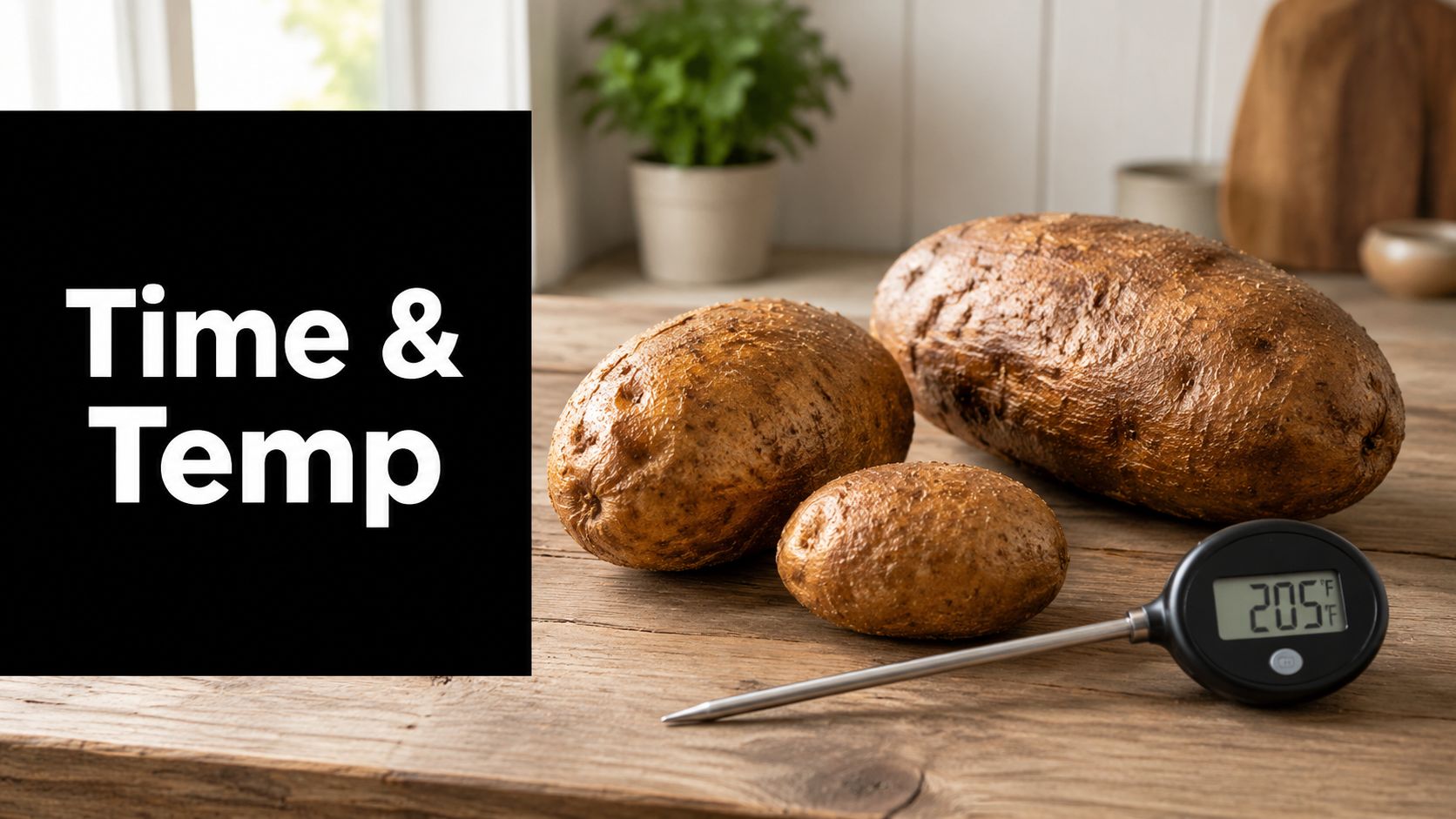
Most baked potato advice is built on a shaky test: poke it, squeeze it, hope for the best. That works just often enough to stick around, but not often enough to be reliable. A potato can feel soft near the surface and still be dense in the center. It can also sit too long, pass the fork test, and turn dry before dinner even starts.
That's why baked potato time and temp gets confusing fast. One recipe says bake longer. Another says crank the heat. A third says wrap it in foil. What matters is simpler than all of that. The only true measure of doneness is internal temperature.
If you want a potato that opens into a fluffy interior instead of a gummy core, stop treating time as the finish line. Time is only an estimate. Your oven runs its own race. So does your air fryer. Potato size changes everything. The thermometer tells you what guesswork can't.
Stop Guessing Your Baked Potato Is Done
The fork test is popular because it's easy, not because it's precise. A fork slides through one part of the potato, but that doesn't tell you whether the center has fully cooked. With baked potatoes, that gap matters. The difference between “almost there” and “perfectly fluffy” is the difference between disappointment and dinner.
One reason this goes wrong so often is appliance inconsistency. The planning notes behind this article point to a common problem: many home ovens and air fryers don't heat evenly, which makes visual cues and timing less dependable. That's exactly why a thermometer beats every old-school doneness test.
Why the usual signals fail
A potato skin can look crisp and finished while the center still needs more time. A potato can also feel tender when pressed, but still slice open with a slightly wet, heavy middle. That's the kind of result people blame on the potato itself when the issue is underchecking.
Practical rule: If you care about texture, stop asking whether the potato “looks done” and start asking whether the center has reached the right temperature.
The better system is straightforward. Bake until the center reaches your target internal temperature. Then pull it. That one change makes baked potato time and temp far more consistent, whether you're using a full-size oven, a countertop air fryer, or a microwave-to-crisp combo.
What this changes in practice
Instead of trusting the clock, use the clock as a cue to start checking. Insert an instant-read thermometer into the center of the thickest part. If it hasn't reached the target, keep cooking. If it has, you're done.
That sounds almost too simple, but it fixes the most common potato failures at once:
- Dense center: The potato needed more cooking, even if the outside looked ready.
- Dry interior: The potato stayed in too long after it had already finished.
- Inconsistent batches: The potatoes weren't the same size, so they couldn't finish at the same time.
Once you start cooking to temperature, baked potatoes become repeatable.
The 205 Degree Secret to Perfect Potatoes
The number that matters is 205°F. That is the point where a baked potato usually shifts from firm and a little heavy in the center to properly fluffy. Time gets you close. Internal temperature tells you whether it is done.

What happens inside the potato
Russets are packed with starch and water. As the potato heats, those starches swell and soften, and the flesh loosens from a tight, raw structure into the dry, fluffy texture people want from a classic baked potato.
That change does not happen on a strict schedule.
A large potato in a cool-running oven can need much longer than the chart suggests. A smaller one in a hot air fryer may finish early. Two potatoes that look identical can still cook at different speeds because moisture content and starting temperature vary. That is why I treat the clock as a prompt to check, not as the final answer.
Why 205°F works so well
In my testing, 205°F to 210°F is the sweet spot for most russets.
- Around 205°F: The center is usually fluffy and fully cooked.
- Closer to 210°F: The interior gets a little drier and mealier, which some people prefer for loading up with butter, cheese, or chili.
- Below 205°F: The middle often stays dense, slightly waxy, or damp.
That range also explains why "fork-tender" is such a weak test. A fork can slide through a potato that still has an underdone core, especially if the outer inch is already soft. The thermometer checks the part that matters most, the center.
A baked potato is done when the center reaches temperature, not when the skin looks right or a fork meets less resistance.
How to check it without guesswork
Use an instant-read thermometer and insert it into the thickest part from the side or top. Aim for the center. If you hit 205°F or a bit higher, pull the potato and let it rest a few minutes so the interior finishes settling.
If the reading is low, keep cooking and check again soon. If one potato is ready before the others, remove it first. Mixed-size batches almost never finish together, and a thermometer is essential for saving dinner.
The tool I'd buy
Skip the big probe setup unless you already own one and use it often. A basic instant-read thermometer does the job better for potatoes because you can check several quickly without opening and closing a long cooking cycle around one fixed probe.
It also prevents a common mistake. Cutting a potato open to inspect the center dumps steam and dries the interior right when it should be finishing. A thermometer gives you the answer in seconds and keeps the potato intact.
Essential Prep Steps for Crispy Skin
Good baked potatoes start before the heat. If the prep is sloppy, the skin suffers first. You end up with a steamed exterior, uneven seasoning, or a potato that bursts where you didn't want it to.
The non-negotiable prep list
- Scrub the skin well. Potatoes grow in dirt, and the skin is meant to be eaten. A quick rinse isn't enough if you want a clean, pleasant bite.
- Dry thoroughly. Water left on the surface turns into steam. Steam is the enemy of crisp skin.
- Pierce the potato. A few fork holes let pressure escape during cooking.
- Coat lightly with oil and salt. Oil helps the skin roast instead of parch. Salt seasons the exterior and improves that classic baked-potato finish.
What works and what doesn't
What works is a potato that goes into the oven or air fryer dry on the outside and lightly coated. What doesn't work is rinsing it and sending it straight in wet, or wrapping it in foil and expecting crispness. Foil traps moisture. Moisture softens skin.
For the best texture, prep each potato individually instead of piling them into a bowl and hoping they're evenly coated. This matters more than people think. Uneven oil means patchy skin. Poor drying means dull skin. Small details show up clearly in the final bite.
Oven Baked Potato Time and Temp Reference
Oven time is a planning tool, not a doneness test. Potato size varies. Oven thermostats drift. Sheet pans, dark pans, convection settings, and crowded racks all change the result. If you want a baked potato that lands right every time, use the clock to know when to check, then finish by internal temperature.
The oven still earns its place because it handles batches well and gives you the most predictable skin-to-center balance. For a standard russet, 400°F is the setting I recommend first. It is forgiving, it cooks evenly, and it gives you enough room to hit a fluffy center without overshooting the skin.
Historical testing behind Idaho potato guidance points to a fully baked potato at about 210°F internal temperature and roughly 1 hour at 400°F, according to the Idaho Potato explanation of baked potato doneness. In practice, I start checking a little before that mark because home ovens rarely hold the exact set temperature for a full hour.

Best oven settings by goal
Use this chart as a starting point, then confirm with an instant-read thermometer inserted into the center from the side:
| Oven setting | Best use | What to expect |
|---|---|---|
| 400°F | Everyday baked potatoes, mixed skill levels, larger batches | Even cooking, good fluffy texture, lower risk of overbrowning |
| 450°F | Faster cooking and crisper skin | Better exterior texture, but less margin for error on smaller potatoes |
A more useful reference than “fork-tender”
For oven-baked russets, these ranges are practical starting points:
- Small potatoes: start checking earlier
- Medium potatoes: expect the classic bake window
- Large potatoes: expect noticeably longer cooking
- Target finish: 205°F to 210°F internal temperature
That last line matters most. “Fork-tender” is too subjective to be the standard. One cook pulls the potato early because the fork slides in near the edge. Another leaves it too long chasing a perfectly soft center. A thermometer cuts through that guesswork.
How to choose between 400°F and 450°F
Choose 400°F if you want the safest default. It gives the interior time to soften gradually, which helps with larger russets and full trays.
Choose 450°F if crisp skin is the priority and you are willing to monitor more closely. Higher heat works well, but size matters more at that setting. A small russet can finish much sooner than a large one, even on the same pan.
I also avoid treating every potato on the tray as if it will finish together. Weighing them or at least grouping them by size saves a lot of frustration. The same kind of small input change matters in other hot-air cooking too, which is why exact setup details affect results in guides like this air fryer bagel timing reference.
Practical oven rules that hold up
- Use 400°F as the default starting point
- Use 450°F for stronger skin texture
- Start checking before the expected finish time
- Pull each potato when the center reads 205°F to 210°F
- Remove smaller potatoes first if baking mixed sizes
A timer gets you in the range. The thermometer tells you the truth.
Air Fryer Baked Potato The Ultimate Conversion Guide
Air fryer baked potatoes are not just “oven potatoes, but faster.” The airflow changes how the skin dries, how quickly the outside browns, and how easy it is to overtrust appearance. A potato can look finished in an air fryer before the center is fully cooked, which is why this method rewards thermometer checks even more than oven baking.

The conversion formula I actually use
Air fryers usually need a slightly lower temperature than a conventional oven and less total time. In practice, this conversion holds up well:
- From a 400°F oven recipe: air fry at 375°F to 380°F
- From a 450°F oven recipe: air fry at 400°F to 425°F
- Expect the air fryer to finish sooner than the oven
- Pull the potato only when the center reaches 205°F to 210°F
That last step is the whole point. Basket color, wrinkled skin, and a fork test can all mislead you, especially in machines that run hot on the outside and mild at the center.
What that looks like by potato size
I get the most consistent results by sizing the potato first, then setting a temperature that matches the skin I want.
At 375°F to 380°F, use these rough starting points:
- Small russet, about 6 to 8 ounces: start checking around 30 to 40 minutes
- Medium russet, about 8 to 12 ounces: start checking around 40 to 50 minutes
- Large russet, 12 ounces or more: start checking around 50 to 60 minutes
At 400°F to 425°F, the skin improves faster, but the margin for error gets smaller. Start checking earlier, especially with smaller potatoes or powerful basket-style air fryers.
These are starting ranges, not promises. Air fryer thermostats drift. Some units concentrate heat at the top. Others run cool unless fully preheated. The thermometer settles the argument in seconds.
A workflow that holds up across different machines
I use a simple process because air fryers vary more than recipe writers admit.
- Preheat for a few minutes if your model allows it. The skin starts drying sooner.
- Oil lightly and salt the skin. Too much oil softens the surface instead of helping it crisp.
- Leave space around each potato. If the basket is packed, you lose the main advantage of the air fryer.
- Flip once if your machine browns unevenly. Many do.
- Probe the center near the end of cooking. Check through the side into the middle, not just near the surface.
Airflow management matters here the same way it does in this bagel in air fryer timing guide. The food is different, but the rule is the same. Crowding reduces circulation and slows reliable browning.
Best uses and real trade-offs
The air fryer is excellent for one or two potatoes when you want crisp skin without heating the whole oven. It is less efficient for a family-size batch. Once potatoes touch or sit too close together, cook time stretches and the skins lose some of their edge.
Use the air fryer when these priorities matter most:
- Crisper skin
- Shorter cook time for small batches
- Lower energy use than a full-size oven
- Easy weeknight cooking
Use the oven when you need:
- More than two or three potatoes at once
- More even batch cooking
- Less babysitting
If an air-fried potato looks perfect outside but feels dense after you split it open, the appliance did not fail. The center did not reach temperature yet. Keep cooking and verify with the probe. That is the difference between a potato that looks done and one that is done.
Microwave Baked Potatoes The Speedy Solution
The microwave is the fastest way to get a potato cooked through when time matters more than skin texture. It's not the method for a very crisp jacket potato. It is the method for a quick lunch, a late dinner, or a weeknight when the oven feels excessive.
When the microwave makes sense
Microwaving works best when your priority is the interior. The center softens fast, and the potato becomes fully usable for topping, mashing, or finishing another way. The trade-off is obvious the moment you touch the skin. It won't have that dry, crackly exterior you get from oven or air fryer cooking.
That doesn't make it inferior. It makes it specialized.
The combo method that solves the texture problem
If you want speed without giving up all the texture, use a two-part approach:
- Start in the microwave to get the interior mostly cooked.
- Finish in a hot oven or air fryer to dry and crisp the skin.
This is the practical move for busy households because it cuts the slowest part of the process. The microwave handles the dense center. The dry heat handles the exterior.
What matters here is restraint. Don't microwave the potato until it's collapsing. Get it close, then transfer it while the skin still has a chance to improve. A light oil-and-salt coating before the second stage helps a lot.
Best use cases
Microwave baked potatoes are especially useful for:
- Quick solo meals
- Meal prep components
- Loaded potato dinners where toppings do most of the work
If you're serving guests or chasing restaurant-style skin, use the oven or air fryer. If you need dinner on the table fast, the microwave earns its place.
Troubleshooting Common Baked Potato Fails
Most baked potato problems start with one mistake. You checked the outside and guessed about the center.
That is why I do not use "fork-tender" as my main doneness test. A fork can slide through a potato that is still a little tight in the core, especially with uneven ovens, crowded sheet pans, or mixed potato sizes. The center temperature is the reliable checkpoint. If it has not reached about 205°F, it is not done.
Problem cause solution
| Problem | Likely cause | Fix next time |
|---|---|---|
| Hard center | Pulled too early | Keep baking until the center reaches the correct temperature |
| Shriveled skin | Overcooked after reaching doneness | Start checking sooner and pull it once the center is ready |
| Pale, soft skin | Surface moisture or foil trapping steam | Dry well and bake uncovered |
| One potato done, one not | Size mismatch or uneven appliance heating | Group similar sizes together and temp each one separately |
The failures I see most often
A firm middle is the classic miss. The skin looks right, the potato gives a little when squeezed, and the timer says it should be done. None of that confirms the center. Insert a thermometer through the side into the thickest part and check. If the reading is short of target, it needs more time. Simple.
Shriveled skin comes from the opposite error. The potato hit doneness, then stayed in the heat while the moisture kept leaving. This happens a lot in air fryers and hot ovens because the exterior dries fast. Good skin should feel crisp, not leathery.
Soft skin has a different cause. Water on the surface, foil wrapping, or overcrowding traps steam and blocks browning. You can still eat the potato, but it will not have that dry, lightly crackled shell that makes a baked potato worth doing in the first place.
How to recover and how to prevent
If the center is underdone, return the whole potato to the oven or air fryer. Keep it intact if possible. A fully split potato loses steam fast, and the interior can dry before the center finishes.
If the skin is soft, the best rescue is a short stint in hotter, dry air. A few minutes in the oven or air fryer can improve it, though rescue never works as well as proper prep. For repeatable results, dry the potato thoroughly, oil it lightly, salt the skin, and leave space around each one so hot air can circulate. If you use an air fryer often, the broader air fryer cooking tips and recipe archive is useful for dialing in timing and airflow habits across different models.
One more practical point. If you are cooking several potatoes, do not assume they will finish together just because they went in together. Temp each one. The thermometer ends the guessing, and it solves more baked potato failures than any trick with foil, fork tests, or extra oil ever will.
Creative Topping and Serving Ideas
A well-baked potato is one of the most flexible things you can put on a plate. It can be a side dish, a budget dinner, a packed lunch base, or a full comfort-food centerpiece. Once the texture is right, toppings do the rest.

The classics that always work
Butter melting into a split potato still sets the standard. Add sour cream, chives, shredded cheddar, and bacon bits, and you've got the iconic version. It works because each topping fills a specific role. Butter adds richness. Sour cream cools and tangs. Cheese clings to the heat. Chives cut through the heaviness.
These toppings aren't boring. They're balanced.
Fresher and lighter combinations
Some of the best baked potatoes lean bright instead of heavy. Try combinations like these:
- Greek yogurt and herbs for a sharper, cleaner finish
- Salsa and black beans for a pantry-friendly meal
- Avocado and green onion when you want creaminess without cheese
- Steamed broccoli with a light cheese layer for a dinner that feels substantial
If you want more snack and meal inspiration built around air fryer cooking, the broader air fryer recipe blog collection is useful for pairing ideas.
Hearty toppings that turn it into dinner
A baked potato transforms into a full meal. A fluffy russet can hold serious toppings without losing its shape if you split it correctly and fluff the center first.
Good dinner-level options include:
- Chili and cheddar
- Pulled pork with sliced scallions
- Broccoli with cheese sauce
- Brisket or shredded beef
- Buffalo chicken with a cooling topping
The trick is contrast. A hot, fluffy interior wants something creamy, something savory, and something with bite. That's why loaded baked potatoes are so satisfying. They hit several textures at once without needing much technique after the potato itself is right.
Frequently Asked Baked Potato Questions
Should you wrap baked potatoes in foil
Usually, no. Foil traps steam, and steam softens the skin. If you want that classic baked exterior, cook the potato uncovered. Foil has a place if your only goal is holding heat, but it works against crispness.
What's the best potato for baking
Russets are the standard pick because they bake up fluffy and their skins hold up well. Yukon Gold potatoes can be excellent too, but they tend to be more creamy than airy. If your ideal baked potato is light and fluffy, russet is the easier choice.
Can you make baked potatoes ahead of time
Yes, but they're best when served soon after cooking. If you need to work ahead, bake them, let them cool, then reheat in dry heat so the skin has a chance to recover. Avoid sealing them up while they're still steaming hot, or the skin will soften.
Do you need a thermometer every time
If your goal is consistency, yes. Once you've baked a lot of potatoes in the same appliance, you'll get better at estimating. Even then, the thermometer is what confirms the center instead of leaving you to guess.
Where can you find more air fryer cooking ideas
If you cook in an air fryer often and want more recipes beyond baked potatoes, browse the collection at Air Fryer Snack Ideas.
Air Fryer Snack Ideas is a practical resource for anyone who wants simple, approachable air fryer recipes without the clutter. If you liked this baked potato time and temp guide and want more easy snack and meal ideas, visit airfryersnackideas.com.
