


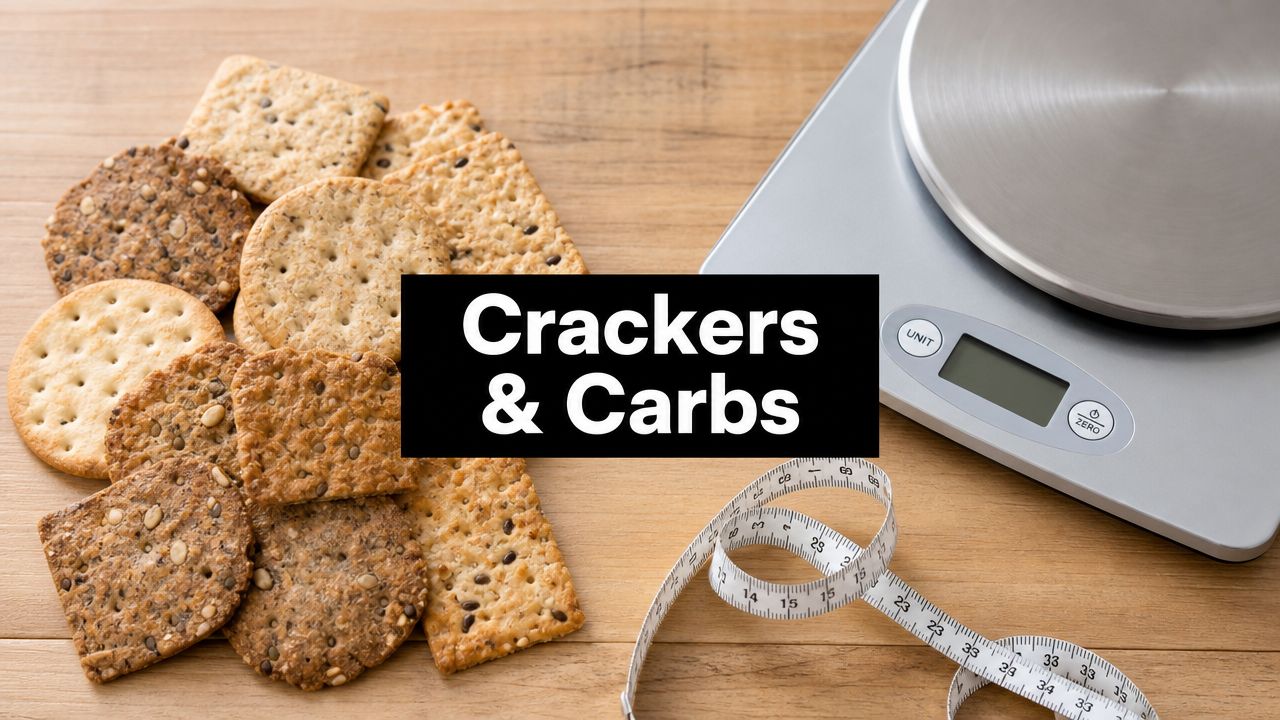
Yes, crackers are a carbohydrate-dominant food. Standard crackers contain about 61 g of total carbohydrate per 100 g, and a common serving is still carb-heavy at about 10 g of total carbs per 16 g serving, roughly 5 crackers.
If you're standing in the kitchen wondering whether a few crackers count as a light snack or a real source of carbs, you're not alone. Crackers often feel small, plain, and harmless, so it's easy to assume they don't matter much. But they do count, especially if you're trying to eat more mindfully, manage blood sugar, or keep snacks lower in carbs.
The good news is that you don't need to swear off crunch. You just need to know what kind of carb you're eating, what a serving looks like, and what to reach for when you want something crispier and more satisfying. If you enjoy practical snack ideas and air-fryer-friendly swaps, you'll find plenty of inspiration at Air Fryer Snack Ideas.
The Cracker Conundrum
You open the pantry for a quick snack, grab a sleeve of crackers, and pause. They do not feel like the kind of food people usually call "carbs." They are light, crisp, and easy to nibble without much thought.
That is where the confusion starts.
Crackers may look small and plain, but they are usually made from flour, which means they land squarely in the carbohydrate camp. They often get treated like a side item, almost like they do not count. In practice, they can add up fast, especially if you eat them by the handful while making lunch or waiting for dinner.
Why crackers confuse people
Part of the mix-up comes from how people use the word carbs. Some use it as shorthand for sweets. Others use it for bread, pasta, and rice, but forget that crunchy grain snacks belong in the same family.
A cracker works a lot like a very small piece of bread that has been baked until crisp. It may not taste sweet, but the starch is still there. That is why a modest-looking serving can affect your snack more than you expect.
Practical rule: If a snack is built mostly from flour, treat it like a carb food, even if it feels light.
Why the answer matters
Knowing this helps you make better snack decisions, not stricter ones.
If crackers are part of your snack, the smarter question is often, "What will I eat with them?" Pairing a small portion with protein, fat, or fiber usually makes the snack more satisfying than eating plain crackers alone. Cheese, tuna salad, hummus, or turkey slices can help slow down the "still hungry" feeling that shows up after a few dry crackers.
It also gives you a clear next step if you want less of the carb load but still want crunch. Instead of forcing yourself to give up crispy snacks, you can swap in foods that deliver the same texture with a different nutrition profile. If you like practical kitchen solutions, these air fryer snack ideas make that switch feel much easier.
A Simple Guide to Carbohydrates
Carbohydrates are the body's quickest-to-use fuel, but they do not all act the same once you eat them. A bowl of beans, a slice of whole grain toast, and a handful of crackers all contain carbs, yet they can leave you feeling very different an hour later.

Simple carbs and complex carbs
A helpful way to sort carbs is by how quickly they digest.
Simple carbs break down fast. Table sugar is the clearest example. Foods in this group can give quick energy, but they often wear off fast too, especially if the food is low in fiber or protein.
Complex carbs have more structure. Whole grains, beans, and starchy vegetables usually fit here. They often digest more slowly, which can lead to steadier energy and a snack that feels more satisfying.
Crackers sit in a gray area that trips people up. They are usually made from grain, so yes, they are a carb food. But many common crackers are made with refined flour, which strips away some of the fiber that helps slow digestion. That is why crackers can feel light and crisp while still acting more like a quick carb than a filling snack.
Where crackers fit
A simple way to read crackers is to ask two questions. What are they made from, and what is missing?
If the main ingredient is refined flour, the cracker is usually closer to white bread than to a high-fiber grain bowl. If it is also low in fiber and protein, it may not keep you full for long on its own.
Here's the plain-English takeaway:
- Carbs are a normal part of eating: Your body uses them for energy.
- The type of carb changes the experience: Crackers made from refined flour tend to be less filling than carbs that come with more fiber.
- What you eat with them matters: Crackers paired with protein, fat, or fiber usually work better as a snack than crackers by themselves.
Carbs are only one part of the picture. Fiber, protein, fat, ingredients, and portion size all shape how satisfying a snack feels.
A lot of the confusion comes from mixing up three separate questions. Is it a carb? Is it filling? Is it lower in carbs than other crunchy snacks? Those answers can be very different, which is exactly why cracker labels matter and why air fryer alternatives can be so useful if you want crunch with a lighter carb load.
Comparing Carb Counts in Popular Crackers
Not all crackers land in the same place nutritionally. Some are standard refined wheat crackers. Some are marketed as whole wheat or multigrain. Others are grain-free or keto-style products built from nuts, seeds, or cheese.
The biggest mistake shoppers make is assuming the name on the front settles the issue. It doesn't. "Multigrain" can still be fairly carb-heavy, and a tiny serving size can make a label look lighter than it feels in real life.
A side-by-side look
| Cracker Type | Total Carbs (g) | Fiber (g) | Net Carbs (g) |
|---|---|---|---|
| Standard wheat crackers | About 10 per ~16 g serving | Not specified in this source | Not specified in this source |
| Kellogg's Club Original Crackers | 9 per 4 crackers (14 g) | 0 | 9 |
| Generic standard crackers per 100 g | 61 | Not specified here | 59 |
| Specialty low-carb crackers made from nuts, seeds, or cheese | Often under 5 net carbs per serving | Varies by product | Under about 5 |
The clearest hard numbers available for common crackers come from broad category data and a mainstream branded example. Foodstruct lists a generic cracker at 61 g total carbohydrates per 100 g and 59 g net carbs, while a serving of Kellogg's Club Original Crackers shows 9 g total carbohydrate per 4 crackers (14 g) with 0 g fiber, according to the Foodstruct cracker nutrition profile.
What this table means in real life
A few patterns stand out.
First, standard crackers are mostly starch. That's why they add up quickly even when the serving looks tiny. Four or five crackers can feel like "almost nothing," but nutritionally they still count.
Second, fiber makes a major difference. In the branded example above, the fiber is 0 g, which tells you that all of those carbs are effectively staying on the board. That's one reason plain buttery or refined crackers often don't keep you satisfied for very long.
Why labels can feel misleading
Serving sizes are useful, but they can also hide how easy it is to overeat a crunchy snack. Many people don't stop at four crackers. They have a handful, then another while making lunch, then a few more while cleaning up.
A cracker label may describe a small serving. Your hand usually serves a larger one.
If you're comparing boxes at the store, don't just scan the marketing terms. Check the serving size, total carbs, and fiber together. That's where the full picture is.
Looking Beyond Total Carbs
Total carbs matter, but they don't answer every practical question. If you're trying to understand how a snack fits into a lower-carb routine, two ideas help a lot: net carbs and how quickly a food is likely to digest.

How net carbs work
Net carbs are usually calculated by subtracting fiber from total carbohydrates. People following low-carb or keto-style eating often pay attention to this number because fiber isn't digested the same way as starch.
Here's the simple version:
- Start with total carbs: This is the big number on the label.
- Subtract fiber: That gives you a rough net carb figure.
- Use that number with common sense: A snack can be low in net carbs and still not be very satisfying if the portion is tiny.
For example, if a cracker has no fiber, the total carbs and net carbs are basically the same. If a specialty cracker has more fiber, the net carbs may come down.
Why conventional crackers can be a poor fit for low-carb eating
Independent nutrition guidance notes that conventional crackers are often unsuitable for keto diets because a single serving can take up a large share of a 30 to 50 g daily carb limit, while some specialty crackers made from nuts, seeds, or cheese can keep net carbs under about 5 g per serving, according to this low-carb cracker overview.
That doesn't mean everyone needs keto crackers. It means the ingredient base matters. A cracker made from refined flour behaves differently from one made mainly from seeds or cheese.
A word about blood sugar and energy
Many standard crackers are refined grain foods, so they tend to digest faster than higher-fiber options. That's why some people notice a quick burst of energy followed by feeling hungry again soon after.
You don't need to obsess over every label. Just remember this: lower fiber usually means a snack is less likely to hold you for long, especially if you eat it plain.
How to Snack on Crackers Smarter
You can absolutely enjoy crackers and still make your snack work better for fullness, balance, and everyday energy. The trick is to stop treating crackers as the whole snack.

Build a better cracker snack
Plain crackers tend to disappear fast. Pairing them with protein, fat, or both usually makes the snack feel more complete.
Try combinations like these:
- Cheese plus crackers: A classic because it adds protein and richness.
- Hummus with a few crackers: Better than eating the crackers dry.
- Avocado on top: Soft, filling, and more satisfying than butter alone.
- Nut butter with a sturdy cracker: Works best when you want something that sticks with you.
Kitchen shortcut: If the cracker is just the crunchy base for something more nourishing, you're usually on a better track.
What to look for on the box
A "better" cracker often has a stronger ingredient list and a nutrition label with more to offer than refined starch alone. Depending on the product, that may mean more fiber, more protein, or ingredients like seeds and legumes.
Research on faba bean flour crackers shows that formulation can shift a cracker's nutrition in a meaningful way. In that study, supplemented crackers had higher protein (16.8 to 43%), higher dietary fiber (6.7 to 12.1%), and higher resistant starch (3.2 to 6%) than standard wheat crackers, while the wheat crackers had only 1.2% resistant starch, according to the peer-reviewed faba bean cracker study.
That kind of product isn't the same as a typical buttery cracker from the snack aisle, but it shows an important point. Crackers don't have to stay nutritionally basic.
Three habits that help immediately
- Portion before eating: Put some on a plate instead of eating from the box.
- Read the ingredient list first: If refined flour leads and fiber is minimal, treat it as a lighter crunch food, not a filling snack.
- Use crackers as one part of the snack: For more everyday snack ideas, browse the recipe collection on the Air Fryer Snack Ideas blog.
Crunchy Low-Carb Air Fryer Alternatives
Sometimes you don't want nutrition theory. You just want something salty, crisp, and fast. That's where an air fryer shines. It can give you that cracker-like crunch without relying on a sleeve of refined flour crackers.

Parmesan crisps
Make little mounds of grated Parmesan on parchment or a liner that works with your air fryer basket. Cook them until melted and golden, then let them cool so they crisp up.
They work well on their own or next to tomato slices, cucumber rounds, or a dip. The flavor is bold, so a small batch goes a long way.
Zucchini chips
Slice zucchini thin, pat it dry, and toss lightly with oil and seasoning. Air fry in a single layer until the slices dry out and turn crisp at the edges.
These won't taste exactly like crackers, but they scratch the same crunchy-snack itch. A little garlic powder or grated cheese helps a lot.
Almond flour crackers
If you want something closer to an actual cracker, make a simple dough with almond flour, seasoning, and enough moisture to press it flat. Cut it into small squares, then air fry until crisp.
This option takes a little more effort, but it gives you the familiar shape and snap people miss when they stop buying boxed crackers.
Crispy cheese bites or ready-made pork rinds
Small cubes or piles of cheese can air fry into crunchy bites with a lot of flavor. If you need the fastest option possible, pork rinds are another crunchy choice that many low-carb eaters keep on hand.
Crunch matters. If you replace crackers with a snack that's soft or boring, you probably won't stick with it.
If you're experimenting with air-fryer snacks, start with one texture goal. Thin and chip-like, cheesy and crisp, or sturdy enough for dipping. Once you know which kind of crunch you want, it gets much easier to choose a satisfying swap.
And if you like adapting familiar foods, even simple bread-based ideas can help you think differently about texture and crispness. A recipe walkthrough like this bagel in air fryer guide shows how much an air fryer can change the eating experience.
Frequently Asked Questions
Are whole-grain crackers low carb
Not necessarily. Whole-grain crackers may offer a different nutrition profile than refined crackers, but they can still be fairly carb-heavy. "Whole grain" doesn't automatically mean low carb.
Are crackers worse than bread
Not always. It depends on the ingredients, fiber, portion size, and what you eat with them. Crackers are easier to overeat because they're small and snackable.
Can crackers fit into a balanced diet
Yes. They can fit just fine when you treat them as one part of a snack or meal instead of the entire snack.
What's the best low-carb crunchy snack
That depends on what you enjoy. Cheese crisps, seed-based crackers, vegetable chips, and other air-fryer snacks can all work well if you want crunch without relying on standard refined crackers.
If you want more snack ideas that are practical, crunchy, and built for real life, visit airfryersnackideas.com. You'll find air fryer recipes and simple inspiration for turning everyday cravings into smarter homemade snacks.
