


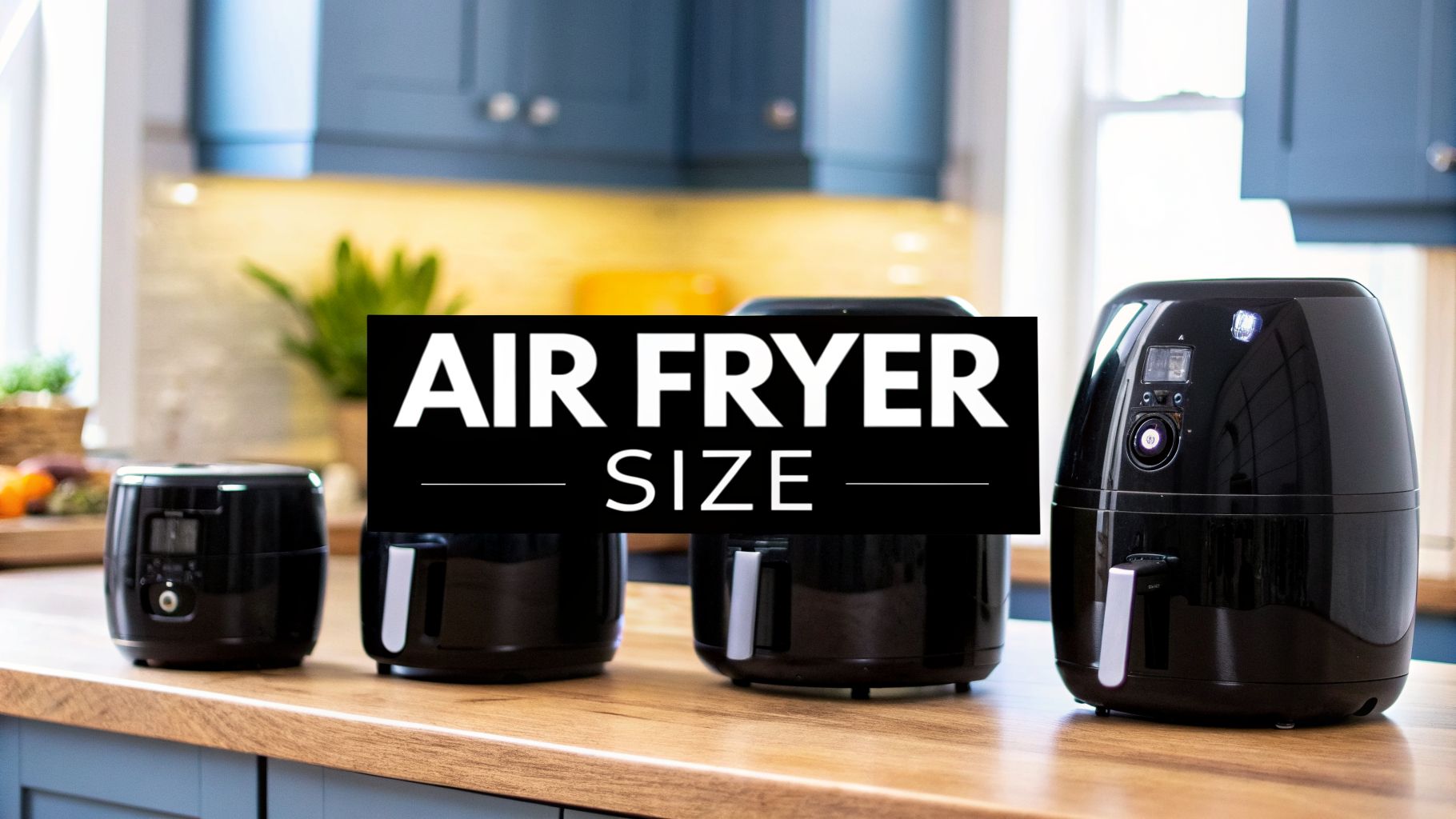
So, you're trying to figure out what size air fryer you really need. Let's cut through the noise. My go-to advice is simple: aim for a 3 to 5-quart model if you're cooking for one or two, a 5 to 8-quart model for a family of three or four, and anything 8 quarts or larger for households of five or more.
Getting this right from the start means you'll have enough room for perfectly crispy results without sacrificing your entire countertop.
How To Choose The Right Air Fryer Size
Picking an air fryer size can feel overwhelming with all the options out there, but it really boils down to two things: how many people you feed daily and what kinds of food you love to make.
Think of it like buying a skillet. You wouldn't use a tiny 8-inch pan to cook burgers for the whole family, right? The same principle applies here. The single most important number on the box is the quart capacity—this tells you the volume of the cooking basket.
More quarts means more cooking space. That space is the secret ingredient for getting that crunchy, golden-brown finish we all crave. The biggest rookie mistake is cramming the basket full. When food is packed in too tightly, you block the hot air from circulating, and you end up steaming your food instead of frying it. The result? Pale, soggy fries. No one wants that.
If you're looking for some delicious inspiration on what to make once you've found your perfect size, we have tons of great air fryer snack ideas to get you started.
Air Fryer Size At a Glance
To simplify your decision, I’ve put together a quick-reference table. It lines up the quart capacity with household size and gives you some real-world examples of what can fit inside.
| Air Fryer Size (Quarts) | Best For (Household Size) | Example Snack Capacity |
|---|---|---|
| 2-4 Quarts | 1-2 People (Singles, Couples) | About 1 lb of chicken wings or 2 servings of fries |
| 5-7 Quarts | 2-4 People (Small Families) | Roughly 2 lbs of chicken wings or 4 servings of fries |
| 8-10+ Quarts | 4+ People (Large Families, Entertainers) | 3-5 lbs of chicken wings or a family-size batch of fries |
Think of this table as your cheat sheet for matching a machine to your lifestyle. It helps you visualize exactly what "5 quarts" means in terms of actual food.
This chart can also help you quickly pinpoint the best fit for your home.

As you can see, the first question is always the same: "Who am I cooking for?" Answering that one question gets you 90% of the way there.
My Pro Tip: If you are ever stuck between two sizes, always go for the larger one. You can’t add more space to a small air fryer, but you can always cook a smaller portion in a big one. That extra room will be a lifesaver when you have guests over or just want to make sure your food has a fighting chance to get perfectly crispy.
Decoding Air Fryer Capacity: From Quarts to Crispy Fries
When you start shopping for an air fryer, the numbers on the box can be a bit of a head-scratcher. You'll see terms like "quarts" and "liters," but what does that actually mean for your weeknight dinners? Let's break down these measurements into something that makes sense for your kitchen.
A quart is just a measure of volume. So, a 4-quart air fryer technically holds four quarts worth of something. But here's the catch: that number refers to the total internal volume of the basket, not the flat, usable cooking space.
From Quarts to Actual Cooking Space
Here's the single most important thing to understand: you can't just fill an air fryer basket to the top. For that magical, crispy texture we all love, hot air has to blast every surface of your food. Overcrowding is the enemy of crispiness.
This is why the basket's surface area—its width and depth—is a much better indicator of how much you can cook at once.
A larger surface area allows you to spread food out in a single, even layer. This is the secret to achieving perfectly golden, crispy results and avoiding the dreaded soggy pile of food that comes from an overcrowded basket.
Think about making a batch of crispy artichoke hearts. If you stack them on top of each other, the ones trapped in the middle are just going to get steamed and mushy. With enough room to breathe, every single piece gets that direct hit of hot air, giving you a beautiful, consistent crunch all around.
Why Quarts Dominate the Market
So if surface area is what really matters, why does every brand lead with quarts? It's simple: quarts are a universal standard that’s easy to market. In the United States, quarts are the norm, while liters are more common elsewhere. The conversion is easy enough—one liter is just a hair bigger than one quart (1 liter ≈ 1.06 quarts).
The air fryer market is booming, expected to hit a staggering US$18.7 billion by 2033, largely because we're all looking for healthier ways to cook. In North America, which makes up 39% of the market, smaller models are king. In fact, somewhere between 60-70% of new buyers opt for 3- to 5-quart models, which are a great fit for singles, couples, or anyone with a small kitchen. You can dig into more of these stats in this air fryer market analysis.
Knowing this helps put things in perspective. That best-selling 3-quart model might seem like a great deal, but if you're trying to feed more than one or two people, you'll feel the pinch of that small basket right away. This is exactly why looking beyond the quart size to the usable space is so critical.
Matching Air Fryer Size To Your Real Life
Forget the spec sheets for a minute. Choosing the right air fryer is less about matching quarts to a headcount and more about matching a machine to your actual life. The perfect air fryer for a college student in a tiny dorm is going to be completely different from what a busy parent needs to get dinner on the table.
So, let's figure out what size you really need by looking at how you cook. Find your own kitchen style in these scenarios, and you’ll know exactly which air fryer will feel like a helping hand, not just another gadget collecting dust.
The Solo Snacker and The Couple
This is you if you're a single person, a college student, or a couple. Counter space might be at a premium, or you just want a fast way to whip up small meals, heat leftovers, or make a killer snack for one or two.
Your go-to's are probably a single salmon fillet, a perfect portion of fries to share, or reviving last night’s pizza. You’re all about speed and convenience, not cooking for an army.
- Recommended Size: 2 to 4 Quarts
- Why it Works: These compact models are brilliant for cooking for one or two people without hogging your counter. A 3-quart air fryer can easily fit two chicken breasts or a generous side of veggies, getting them crispy and cooked through in no time.
- Real-World Example: Imagine you want a quick, warm snack. You can toss a sliced apple with some cinnamon, pop it in a small air fryer, and have a delicious, healthy treat in minutes. No need to preheat a giant oven.
The Busy Family Feeder
If you're in a family of three or four, this is your zone. The kitchen is command central, and you need an appliance that can pull its weight during the weeknight dinner rush. You're not just making snacks—you're cooking entire main courses.
You need a workhorse that can handle a whole bag of chicken nuggets for the kids, roast broccoli for everyone, or crisp up enough wings for game night. The last thing you want is to cook in batches while everyone's hungry. You need it all done at once.
The mid-size range is the real sweet spot for most families. It strikes the perfect balance between a manageable countertop footprint and the capacity to cook a full meal. This is where you'll find the most innovation and the best-selling models.
There's a reason the air fryer market is exploding, and this category is a huge part of it. Market.us projects that global air fryer revenue will hit a staggering $1,803 billion by 2032. In North America, a massive 40% of sales are for 5- to 8-quart models—perfect for households of 3-5. These units can cook 3-4 pounds of wings in about 20 minutes, using 20-30% less energy than your big oven. You can dig into more of this data in this air fryer industry report.
- Recommended Size: 5 to 8 Quarts
- Why it Works: A 6-quart air fryer, for instance, gives you enough surface area to cook about two pounds of fries or a dozen wings without them all piling on top of each other. This space is crucial for letting hot air circulate, which is what prevents steaming and gets you that signature crunch.
The Weekend Entertainer and Meal Prepper
You're the person who loves having friends over for dinner or who dedicates Sunday afternoon to prepping meals for the entire week. You might have a large household of five or more, or you just prefer to cook in big, efficient batches. For you, capacity is king.
You’re looking to roast a whole 4-pound chicken, toast several bagel halves at once, or air fry an entire party-sized bag of tater tots without breaking a sweat. You need maximum space and versatility. Speaking of bagels, if you want to branch out, we have a great guide on how to make a perfectly toasted bagel in your air fryer.
- Recommended Size: 8 Quarts or Larger (including oven-style models)
- Why it Works: Big baskets and oven-style air fryers give you the real estate you need. Oven models often come with multiple racks, so you can cook your main course and a side dish at the same time—think salmon on the top rack with asparagus roasting below. An 8-quart basket or a large oven ensures you’re cooking for the crowd, not stuck in the kitchen running endless batches.
Choosing Your Shape: Basket vs. Oven Style

Okay, so you've got a handle on how many quarts you might need. But that's only half the story. The other, equally important piece of the puzzle is the air fryer's physical shape. The design—whether it’s a pull-out basket or a miniature oven—fundamentally changes what you can cook and how you cook it.
Choosing between a basket-style and an oven-style model is one of the biggest decisions you’ll make. Each has its own personality and strengths, and the right one for you comes down to your cooking habits, family size, and how much counter space you’re willing to give up.
The Classic Basket-Style Air Fryer
Think of a basket-style air fryer as a compact, super-powered convection pod. It's built around a deep drawer that you pull out, fill with food, and slide back in. This focused design is incredibly efficient and what most people picture when they think of an air fryer.
These are the most common models out there, especially in the small-to-mid-size range of 3 to 8 quarts. Their design creates a vortex of intense heat that makes them absolute champs at getting food crispy.
Why Choose a Basket-Style Model?
- Superior Crisping: That smaller chamber concentrates the hot air, creating an unbeatable crispy finish on things like french fries, chicken wings, and Brussels sprouts.
- Simple and Fast: They tend to preheat quicker than their oven-style cousins and are dead simple to use. Just pull out the basket, add your food, and get cooking.
- Perfect for Shaking: The basket and handle design is tailor-made for tossing food mid-cook. This is key for getting everything evenly browned without any fuss.
- Compact Footprint: Basket models generally have a smaller footprint, making them a fantastic choice for smaller kitchens, apartments, or even dorm rooms.
If your main goal is to make perfectly crispy "fried" foods for a few people at a time, this is your workhorse. The only real downside is the cooking surface is limited, so you’re stuck with a single layer and can’t easily cook delicate items that might get crushed by shaking.
The Versatile Oven-Style Air Fryer
An oven-style air fryer looks and feels more like a high-tech countertop convection oven. Instead of a deep basket, it has a wide cooking chamber with a glass door and, most importantly, multiple racks or trays. This layout completely opens up what's possible with air frying.
These models typically start at larger capacities, often 10 quarts or more, and they almost always come with a whole suite of accessories like rotisserie spits, baking pans, and wire racks.
An oven-style air fryer is less about replacing your deep fryer and more about replacing your big oven for everyday jobs. It brings multi-level cooking, better visibility, and the flexibility to bake, roast, and toast with countertop convenience.
Think of it as the ultimate kitchen multi-tasker. You can air fry a whole sheet pan of veggies on one rack while baking a small batch of cookies on another. The flat, wide trays are perfect for spreading food out in an even layer or for cooking things you could never toss in a basket, like fish fillets or breaded cutlets.
Why Choose an Oven-Style Model?
- Multi-Level Cooking: Using multiple racks at once is a game-changer, letting you cook entire meals or large batches of flat foods in one go.
- Incredible Versatility: These aren't just for air frying. Most can also bake, roast, broil, toast, and even dehydrate, consolidating several appliances into one.
- Better for Delicate Foods: The flat trays let you cook fish, breaded items, or even reheat pizza without breaking them apart.
- Rotisserie Function: Many models come with a rotisserie spit for making a perfectly crispy, self-basting whole chicken—something a basket model just can't do.
The trade-off for all this amazing versatility, of course, is a larger physical footprint. They take up more counter real estate and can sometimes have slightly less intense crisping power than a dedicated basket model. Ultimately, the right "size" air fryer for you is as much about its shape and function as it is about its quart capacity.
What To Measure Before You Buy

Okay, you've decided on the capacity you need and have a good idea of whether a basket or oven-style air fryer is right for you. Before you hit that "buy" button, though, we need to talk about a different kind of size—the actual physical footprint the machine will take up in your kitchen.
It’s the number one mistake I see new buyers make. They get so caught up in quart capacity that they completely forget to measure their countertops. The result is a brand-new appliance that’s either too tall to fit under the cabinets or so wide it takes over their entire prep space.
Let's avoid that frustration. Grab a tape measure and let's walk through three key measurements that will guarantee your new air fryer is a perfect fit.
Measure Your Countertop Space
First things first, where is this appliance going to live? Go to that exact spot on your counter and measure the available width, depth, and—most importantly—the height. That space between the countertop and the bottom of your upper cabinets is often the biggest constraint.
But don't just measure for the machine itself. Air fryers need to breathe. They have vents, usually on the back or top, that push out hot air. You absolutely must leave some clearance on all sides for proper ventilation.
- Height: Measure from the counter to the base of your cabinets.
- Depth: See how far it will stick out from the wall, making sure it doesn't obstruct a walkway.
- Width: Leave enough room on the sides to easily access the basket or door.
Skimping on this buffer zone is a recipe for trouble. It can trap heat, which could damage your cabinets or even the appliance over time. It’s a simple check that prevents a major headache.
Pro Tip: A new air fryer is not a piece of furniture—you can't just shove it against the wall. A good rule of thumb is to add 4-6 inches to the manufacturer's listed dimensions to account for the ventilation space it needs. If you don't have that room, it's not the right model for you.
Check Your Storage Situation
Now, think about where the air fryer will go when you're not using it. If you have a dedicated spot on the counter, great! But if you plan to tuck it away in a pantry or a deep cabinet, measure that space, too.
Larger, oven-style models can be surprisingly heavy and awkward to move. Be honest with yourself—are you really going to haul a 20-pound appliance out of a low cabinet every time you want to make fries? If it's a pain to access, you won't use it.
Understand Your Power and Wattage Needs
Finally, let's talk power. An air fryer is a high-performance machine, and its wattage rating tells you exactly how much electricity it pulls from the wall. This number is a big deal for both performance and safety.
Most air fryers fall somewhere between 800 to 1800 watts.
- Higher Wattage (1500-1800W): These powerhouses preheat in a flash and hold their temperature steady, which is the key to getting that perfect, crispy finish. The trade-off is that they draw a lot of power.
- Lower Wattage (800-1200W): Perfect for smaller apartments, dorms, or older homes whose circuits might not handle a high-draw appliance. They get the job done, just a bit more slowly.
The air fryer market has exploded, largely driven by busy professionals and students who need quick meals. According to market data, a huge part of the appeal is the 25-35% energy savings smaller units offer over a full-sized conventional oven. You can dive deeper into these trends in this detailed report from Stratview Research.
Before you commit, check the wattage. Think about what else might be running on the same circuit. Tripping the breaker right in the middle of cooking dinner is an annoyance you can easily avoid with a little planning.
Common Questions About Air Fryer Sizes
Even after you've wrapped your head around quarts and baskets, a few practical questions always seem to pop up. Let's tackle some of the most common ones I hear, so you can feel completely confident when you choose your new air fryer.
Can I Cook A Whole Chicken In A 5-Quart Air Fryer
Yes, you can—but with a few caveats. A 5-quart model can generally fit a smaller bird, usually around 3-4 pounds. The real decider, though, is the shape of the basket. You'll have much better luck with a square basket than a round one, as it offers more usable space.
The key to a perfectly crispy chicken is making sure hot air can circulate all the way around it. If the fit is too tight, you'll end up steaming the sides instead of crisping them. When in doubt, always double-check the manufacturer's guide for the maximum size and weight they recommend.
Is It Better To Get A Bigger Air Fryer Than I Need
I almost always recommend sizing up if you have the counter space. A slightly larger air fryer isn't just for cooking for a crowd; it gives you breathing room for everyday meals.
Overcrowding is the number one cause of soggy, steamed food. Spreading ingredients out in a single layer is crucial for achieving a crispy texture, and a larger basket makes this much easier. Just make sure the bigger model's physical footprint still works for your kitchen.
Do Dual-Basket Air Fryers Have Double The Capacity
This is a common misconception. A 9-quart dual-basket air fryer actually contains two separate 4.5-quart baskets. It does not give you one giant 9-quart space, so you won't be able to cook a large item, like a whole chicken, that would fit in a single-basket 9-quart model.
What you get instead is incredible versatility. You can cook crispy fries in one basket and salmon in the other, at entirely different temperatures and times. Think of it as having double the cooking options, not double the size for a single food.
How Much Do Racks Really Add To The Capacity
Racks are a great way to increase your cooking surface area, but they don't magically double your capacity. Since airflow is everything, you can realistically expect to cook about 1.5 times the amount of food you could without a rack, not a full two times.
To get the best results, you’ll also need to play an active role. About halfway through the cooking time, you should pause and swap the items on the top and bottom racks. This simple step ensures everything gets a chance to get hit by the direct heat and crisp up evenly. For more tips on getting the most out of your machine, check out the other articles on our air fryer blog.
