


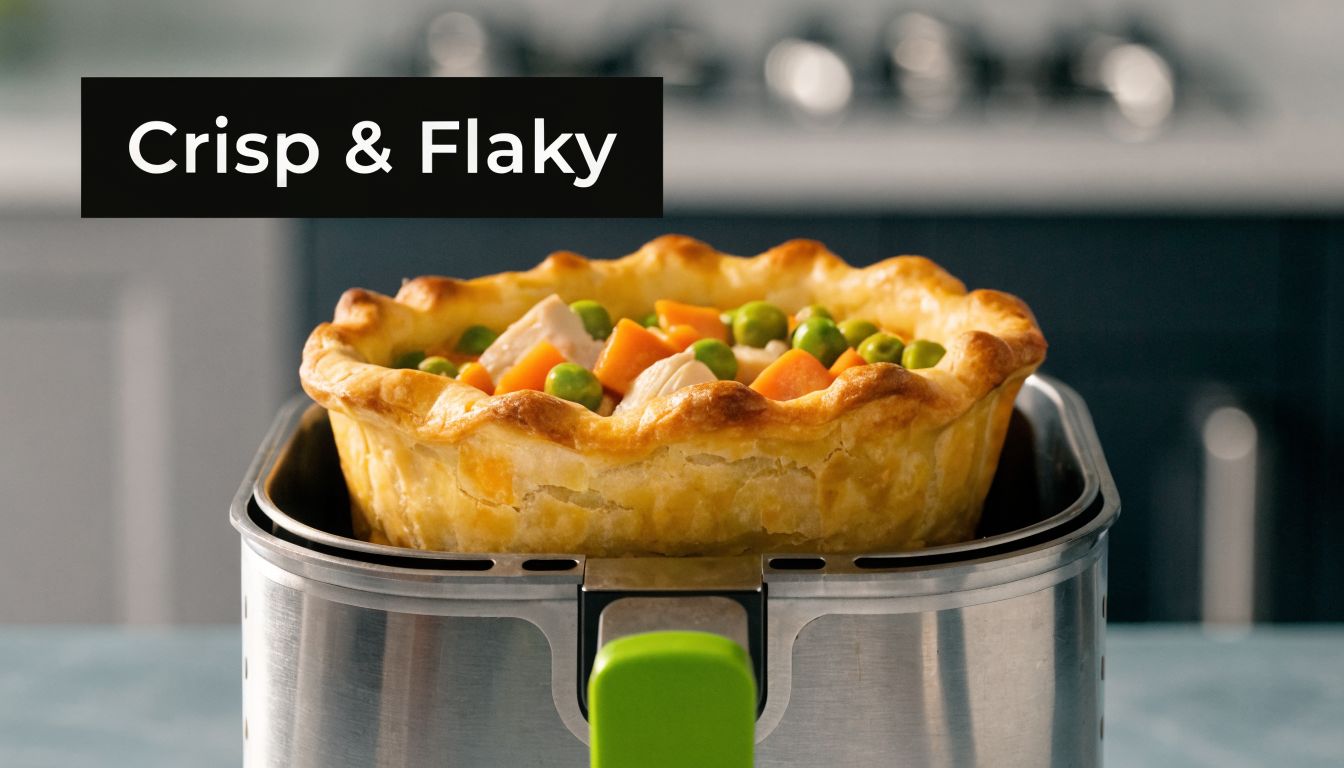
TL;DR: For a standard 6 to 7 oz air fryer frozen chicken pot pie, start at 350°F for about 19 to 22 minutes and make sure the center reaches 165°F before eating. It’s much faster than the oven and gives you a far crispier crust than the microwave.
Cold evening, low energy, one frozen pot pie in the freezer. That’s usually when this method earns its keep.
A conventional oven will get the job done, but it asks for patience you may not have after work, after class, or while juggling dinner for everyone else. The microwave goes the other direction. It’s fast, but the crust turns soft and tired instead of flaky. The air fryer lands right in the sweet spot. You get speed, real browning, and a center that feels like dinner instead of compromise.
The trick is knowing that not every pie cooks the same. A small Banquet pie behaves differently from a larger Marie Callender’s. Brand, weight, crust thickness, and filling density all matter. Once you understand the framework, you stop guessing and start turning out pot pies with a golden top and a hot, bubbly middle on purpose.
The 30-Minute Pot Pie Miracle
The usual frozen pot pie problem isn’t flavor. It’s timing.
You want something warm and comforting, but you don’t want to wait for the oven, heat the kitchen, and babysit a pie for most of an hour. That’s where the air fryer wins. A frozen pot pie goes from freezer to plate fast enough to feel practical on a weeknight, but still comes out with the texture people want.
Microwaves make the filling hot enough, eventually. The crust is the trade-off. The top softens, the bottom goes limp, and the whole thing eats like a compromise meal. An air fryer does the opposite. It moves hot air around the pie, so the crust browns and the filling heats more evenly.
I like this method most for those nights when “real dinner” needs to happen with almost no planning. A Banquet pie for one person, a Marie Callender’s for someone who wants a bigger meal, and dinner is moving without much cleanup.
The best reason to cook an air fryer frozen chicken pot pie isn’t novelty. It’s that the crust finally matches the comfort of the filling.
The biggest mindset shift is simple. Stop treating every boxed pie as if it needs one universal setting. Size matters. So does brand. Once you cook by weight and watch the crust, you get much more reliable results.
If you like practical air fryer ideas beyond pot pies, the broader air fryer recipe collection on this blog is worth browsing for the same kind of no-fuss meals and snacks.
Prepping Your Pie for Air Fryer Success
Before the pie ever hits the basket, a few small decisions decide whether you get flaky and crisp or soggy and uneven.

Cooking frozen chicken pot pies in an air fryer typically means preheating to 350°F and air frying for 19 to 25 minutes until the center reaches 165°F, and this method can cut cooking time by up to 50% compared to a conventional oven, according to Simply Air Fryer’s frozen pot pie guide.
Start from frozen
Don’t thaw the pie first. Frozen pot pies are built to cook from frozen, and the crust holds up better that way. Once the crust softens in the refrigerator, the underside is more likely to turn heavy instead of crisp.
That’s especially true with small pies. They don’t have much margin for error. If the crust starts soft, the air fryer has to fight moisture before it can start browning.
Preheat and vent the crust
Preheating helps more than many people think. A hot basket starts setting the bottom crust right away, which gives you a better shot at avoiding that damp underside nobody wants.
Use this quick prep routine:
- Remove the outer box and any plastic wrap.
- Keep the foil base on if the pie came in one.
- Cut a few small slits in the top crust if it isn’t already vented.
- Preheat the air fryer before the pie goes in.
- Lightly grease the basket if sticking has been an issue with your model.
Practical rule: Steam needs somewhere to go. If you don’t vent the top, moisture can push up under the crust and work against browning.
Give the pie space
Single-layer placement matters. If you’re cooking more than one pie, don’t crowd them so tightly that air can’t move around the sides. The air fryer does its best work when hot air can circulate freely.
This step sounds minor, but it’s one of the easiest ways to ruin the texture. Crowding traps steam. Steam softens crust. Crisp crust depends on airflow.
Your Ultimate Air Fryer Pot Pie Cooking Guide
The method that works most consistently for an 8 to 10 oz air fryer frozen chicken pot pie is a two-stage cook. You start lower so the filling can catch up, then finish hotter so the crust gets that browned, flaky top instead of staying pale.
A benchmark method for a standard 8 to 10 oz pie is to preheat to 360°F, cook for 21 minutes, then raise the heat to 400°F for 2 minutes, with a rest afterward so the center reaches 165°F, according to Temecula Blogs’ air fryer pot pie method.

The step-by-step method
Use this when you want the most reliable combination of crisp crust and hot center.
Preheat the air fryer.
For larger individual pies, preheat to 360°F.Set the pie in the basket.
Keep it in its foil base if it has one, and don’t stack anything around it.Cook the main cycle.
Let the pie cook at the lower temperature first so the filling heats before the crust gets too dark.Check the top near the end.
If it still looks pale, use the hotter finishing step.Finish for color and texture.
A short blast at higher heat gives the crust better browning.Rest before serving.
Leave it alone for several minutes so the heat can move into the center.
Air Fryer Pot Pie Cooking Times & Temperatures
| Pie Size (Weight) | Initial Cook Temp | Initial Cook Time | Final Crisp Temp & Time |
|---|---|---|---|
| 6 to 7 oz | 350°F | 20 minutes | None needed in many cases, or adjust only if pale |
| 8 to 10 oz | 360°F | 21 minutes | 400°F for 2 minutes |
| 8 to 10 oz alternative range | 325 to 350°F | About 25 minutes | Optional brief finish if needed |
That table gives you a framework, not a rigid law. Small pies often cook through faster but can brown on top before the center feels fully ready. Larger pies usually benefit from the dual-temperature method because they need more time for the filling to catch up.
How brands usually behave
Banquet and Marie Callender’s don’t always cook the same way, even when both are “individual” pies.
- Banquet small pies: These tend to cook faster because they’re smaller and thinner. Watch the top early.
- Marie Callender’s larger pies: These usually reward the lower-and-then-higher approach because there’s more filling to heat through.
- Dense filling brands: If the center still seems cool after the main cycle, add a little more time before the final crisp step rather than blasting the top too early.
What I’d do by size
For a 6 to 7 oz pie, I’d treat 350°F for around 20 minutes as the baseline and start checking for doneness near the end. That lines up with the size-based cooking curve used in testing for smaller pies.
For an 8 to 10 oz pie, the two-stage method is the safer bet. It protects the crust while giving the center more time.
If a pie is getting dark before the filling is ready, the answer usually isn’t more heat. It’s more control.
One more practical point. Very large pies are awkward in many basket-style air fryers because the airflow gets blocked. If the basket is tight, you’re fighting the machine instead of using it well. Individual pies are where the air fryer frozen chicken pot pie method shines.
Pro Tips for a Flawlessly Crisp Crust
A cooked pot pie isn’t automatically a great pot pie. The details after basic doneness are what separate “good enough” from “I’d make it this way every time.”
For optimal results, especially with 8 to 10 oz pies, cooking at 325 to 350°F for about 25 minutes is a strong approach, and if the edges brown too quickly, foil tenting is a proven fix. That same guidance also stresses checking for 165°F internal temperature with a thermometer to avoid undercooking, as explained in Upstate Ramblings’ frozen pot pie air fryer guide.
Use a foil shield when the crust gets ahead
The outer rim often browns first. That’s normal. If the edge is getting dark while the center still needs time, loosely tent the crust edge with foil.
Don’t wrap the whole pie tightly. You’re not steaming it. You’re just protecting the parts that are already where they need to be.
Resting matters more than people think
Straight out of the basket, the center can still be catching up. Resting the pie lets the filling settle and the heat distribute more evenly through the middle.
That rest also helps with eating quality. The filling thickens slightly instead of running everywhere when you cut into it.
Worth the extra step: Probe the center with an instant-read thermometer. It removes the guesswork and tells you whether the filling is actually ready.
A few small upgrades
If you want a more polished finish, these help:
- Light basket spray: Useful if your air fryer tends to grab onto the foil or crust.
- Optional egg wash on homemade frozen pies: This can deepen the color and give the top a shinier finish.
- Model notes: Keep track of whether your Ninja, Cosori, or other machine runs a little hot or a little cool. That pattern shows up fast after one or two pies.
If you enjoy crisp, browned baked foods in the air fryer, the same texture-first mindset also helps with things like a bagel in the air fryer, where timing and surface browning matter just as much as raw speed.
Reheating Leftovers and Troubleshooting Common Issues
Microwaving leftover pot pie seems convenient, but it usually wrecks the crust. If the original appeal was flaky pastry and bubbling filling, the microwave throws away half the reason to eat it.

How to reheat it well
The air fryer is the better choice for leftovers because it restores the crust instead of softening it further.
A practical approach is simple:
- Use moderate heat: Lower heat gives the filling time to warm without scorching the crust.
- Cover only if needed: If the top is already dark, a loose foil cover helps.
- Check the center before serving: You want the filling hot all the way through, not just the pastry revived on top.
Three common failures and the fix
Soggy bottom
This usually traces back to skipped preheating or blocked airflow. If the basket wasn’t hot when the pie went in, the bottom didn’t get that early head start. If you packed in multiple items too tightly, steam collected under the crust.
Fix it next time by preheating, using a single layer, and giving the pie breathing room.
Burnt top and cool center
This is the classic sign that the crust cooked faster than the filling. Smaller pies can do this, but larger pies are even more prone when the temperature starts too high.
The fix is control. Start lower, then finish hotter only when the center is nearly there.
Center still underdone
Sometimes the pie just needs more time because of brand differences, filling density, or your machine running a little cool. That doesn’t mean the method failed. It means your air fryer has its own rhythm.
A pot pie can look done before it is done. Color tells you about the crust. The center tells you whether dinner is actually ready.
Air Fryer Pot Pie Questions Answered
A few questions come up every time people make an air fryer frozen chicken pot pie for the first time.
Can I cook more than one pot pie at a time
Yes, if both pies fit in a single layer with space for air to move around them. If they’re pressed together, the crusts trap steam and won’t brown as well. Two small pies can work nicely in a larger basket. Two oversized pies usually don’t.
Do I need to spray the basket
Not always, but it’s helpful if your air fryer tends to stick or if the pie base shifts when you lift it out. A light spray is enough. You don’t want oil pooling under the crust.
Should I remove the aluminum tin
No, leave it in place if the pie comes in a foil base. It supports the pie, helps contain the filling, and makes transfer easier. Just use care when lifting it out because the base gets hot.
Does this work for homemade frozen pot pies
Yes, but treat homemade pies as their own category. Crust thickness, pan type, and filling depth vary a lot more than store-bought brands. Use the same general framework, watch the top closely, and verify the center before serving.
Can I use this method for every brand
Usually, yes, but don’t assume Banquet and Marie Callender’s behave identically. Small pies tend to need less time. Larger pies usually benefit from the slower start and hotter finish.
Where can I find more air fryer basics
If you’re building confidence with your machine and want more practical recipes and snack ideas, start with the main air fryer snack ideas site.
If you want more practical air fryer recipes that skip the guesswork, visit airfryersnackideas.com for snack ideas, quick meals, and simple methods that work in real kitchens.
